

What Size Sauna Do I Need? 1, 2, 4 and 6 Person Saunas Explained
The right sauna size depends on how many people will normally use it, how much personal space you want and the physical space available in your home or garden.
As a simple starting point, a 1-person sauna works well for dedicated solo use, a 2-person sauna suits an individual wanting more room or a couple, a 4-person sauna is better suited to households and small groups, and a 6-person sauna makes most sense when shared sessions are genuinely part of the plan.
However, the person rating alone is not enough to choose a sauna. Two models carrying the same capacity label can have very different footprints, bench layouts, heater outputs and installation requirements.
This guide explains how 1, 2, 4 and 6-person saunas compare and, more importantly, how to work out what will actually fit your property and the way you plan to use it.
What Size Sauna Do I Need?
For most buyers, the best sauna is the smallest size that comfortably accommodates the number of people who will regularly use it, with enough room for your preferred seating position.
That means you should size the sauna around normal use rather than the largest group you might theoretically invite once or twice a year.
| Sauna capacity | Generally best suited to | Example external dimensions from current models |
|---|---|---|
| 1 person | Regular solo use and compact spaces | Around 900 × 900 × 1900 mm |
| 2 person | Couples or solo users wanting extra space | Around 1200 × 900–1050 × 1900 mm |
| 4 person | Families and regular shared sessions | Around 1800 × 1200–1800 × 2000 mm |
| 5–6 person | Families, groups and larger wellness areas | Around 2000 × 1700 × 1900 mm |
| 4–6 person barrel | Garden and social use | Around 1800 × 2100 × 1800 mm |
These are real examples rather than standard dimensions. Current Gym Fitness Store products illustrate how widely the shape and footprint can vary even within the same advertised capacity.
You can compare the different capacities, heater types and indoor or outdoor designs in the Gym Fitness Store sauna collection.

What Does a Sauna's Person Rating Actually Mean?
A sauna's person rating tells you approximately how many people its seating arrangement is designed to accommodate. It does not mean that every sauna rated for four people has the same internal dimensions or provides the same amount of space per person.
This is important because people use saunas differently.
Four people sitting upright require much less bench length than two people who want extra elbow room or one person who wants enough space to stretch out. A corner cabin with L-shaped seating also uses its footprint differently from a rectangular cabin or barrel sauna.
Think about capacity in terms of how you want to use the benches, not simply how many bodies could technically sit inside.
If you are deciding between two capacities, ask:
- How many people will use the sauna during a normal session?
- Do you prefer sitting upright or stretching your legs out?
- Would you like enough room to change seating position?
- Will different members of the household regularly sauna together?
- Is conserving floor space more important than having extra room?
Those answers are usually more useful than choosing the largest capacity your room can accommodate.

Is a 1 Person Sauna Big Enough?
A 1-person sauna is usually the most practical choice if you will almost always use the sauna alone and floor space is limited.
Compact infrared cabins can fit into home gyms, spare rooms and other suitable indoor spaces without requiring the footprint of a larger wellness room.
For example, one current 1-person infrared sauna at Gym Fitness Store measures 900 mm wide × 900 mm deep × 1900 mm high, giving it a footprint of just 0.81 m². Its 1,550 W infrared system is also designed for connection to a standard UK socket.
Who should consider a 1 person sauna?
It makes particular sense if you:
- expect predominantly solo sessions;
- have a relatively small installation area;
- want to preserve space in a home gym or spare room; or
- value a compact cabin more than having room to spread out.
The compromise is obvious: there is little flexibility if another person wants to join you.
It is also worth checking the bench dimensions, not just the external cabinet dimensions. Two 1-person cabins can look similar externally while providing noticeably different seating positions internally.

Is a 2 Person Sauna Worth Choosing for One Person?
Yes. A 2-person sauna can be an excellent choice for one regular user who values additional space.
A larger bench can make it easier to adjust your seating position, store a towel beside you or simply avoid the more enclosed feel of the smallest cabins. You then retain the option of sharing the sauna occasionally.
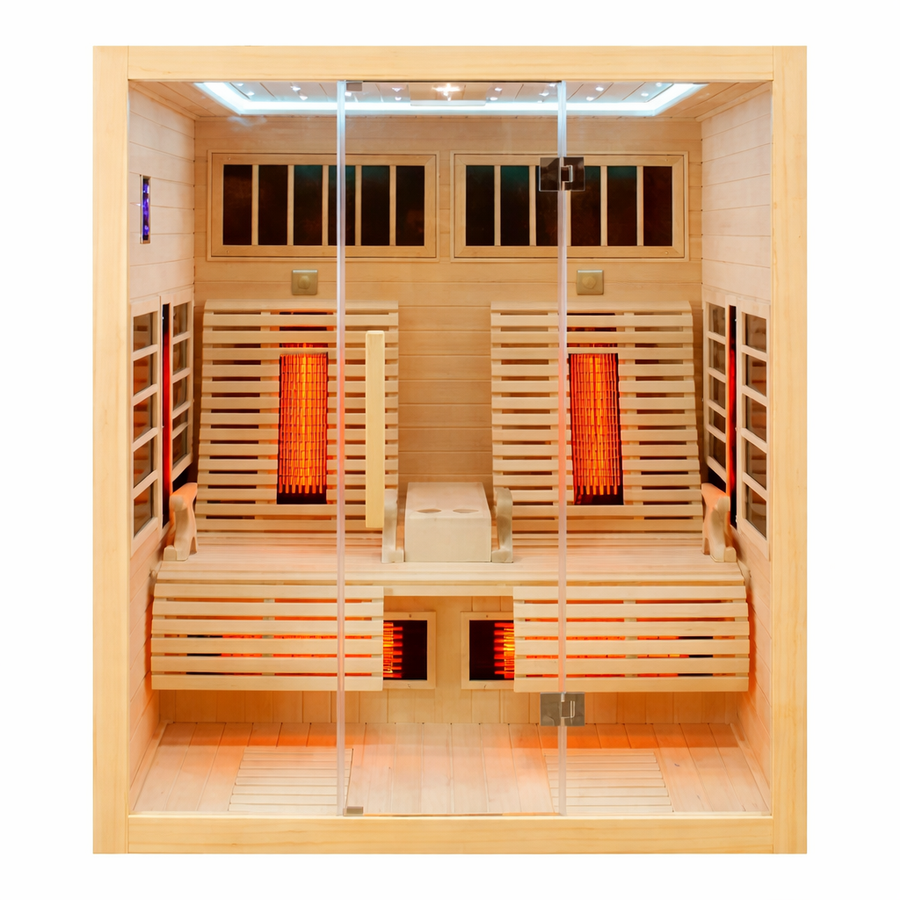
Two-person models can still be relatively compact. Current Gym Fitness Store examples include a 2-person infrared sauna measuring 1200 × 1050 × 1900 mm and another at 1200 × 900 × 1900 mm.
For a couple who normally wants to sauna together, a 2-person model is the logical starting point. However, check photographs, internal bench dimensions and the seating arrangement rather than assuming that every cabin labelled “2 person” will provide the same level of comfort.
Does a 2 person sauna need more electrical work?
Not necessarily.
This is one area where capacity labels can be misleading.
A current 2-person infrared model from Gym Fitness Store uses a 1,750 W infrared system and a standard UK plug. A current 2-person traditional sauna of very similar external dimensions uses a 3,000 W heater and specifies a hardwired 16 A connection.
The heating technology and individual product specification therefore matter more than the words “2 person”.

What Size Is a 4 Person Sauna?
There is no universal 4-person sauna size.
Current examples show just how significant the difference can be. Gym Fitness Store has a 4-person full-spectrum infrared sauna measuring 1800 × 1200 × 2000 mm, while one 4-person outdoor traditional sauna measures 1800 × 1800 × 2000 mm.
That is a substantial difference in floor area despite both being described as 4-person saunas.
A 4-person model is worth considering when several members of the household expect to use the sauna together, you regularly want to share sessions with friends, or you simply want more bench space.
It is also the point where installation planning becomes particularly important.
Larger cabins may involve:
- a larger dedicated floor area;
- higher electrical demand;
- more substantial delivery components;
- additional clearance around the structure;
- a larger or more carefully prepared outdoor base; and
- more room for the door to open comfortably.
If you expect only one or two people to use the sauna most of the time, do not automatically assume that four seats are better. Extra unused volume still has to be heated.

What Size Is a 6 Person Sauna?
A 6-person sauna is generally intended for larger households, regular group sessions or homeowners creating a substantial dedicated wellness space.
Again, the design makes a major difference.
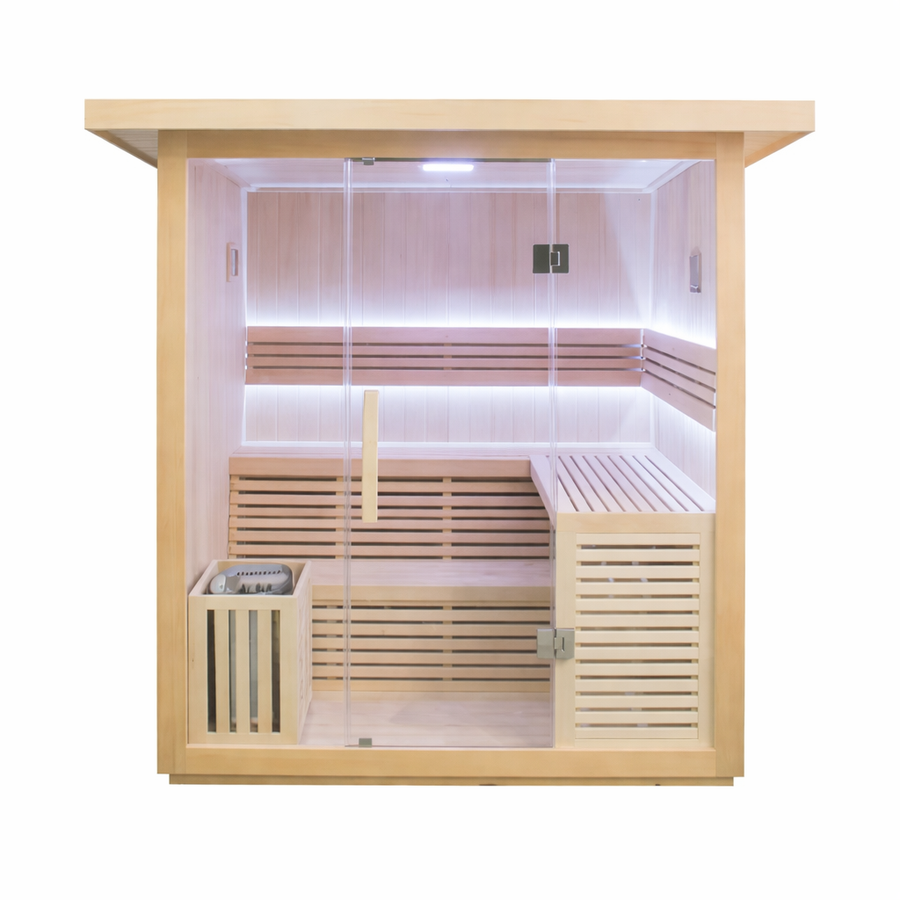
A current 5–6 person indoor traditional sauna at Gym Fitness Store measures 2000 × 1700 × 1900 mm. A 4–6 person outdoor barrel model measures 1800 × 2100 × 1800 mm.
Neither should be treated as the standard measurement for every six-person sauna.
Barrel saunas in particular use their internal space differently from conventional rectangular cabins because of their curved walls and opposing bench layout.
A 6-person model makes more sense when the extra capacity will actually be used. Buying it simply because there is enough room in the garden can mean paying for and heating considerably more sauna than your household needs.
Should I Buy a Bigger Sauna Than I Think I Need?
Sometimes, but not automatically.
Sizing up by one capacity can make sense if you are choosing between two models and value extra personal space. Someone buying primarily for solo use might prefer a 2-person cabin, for example, while a couple who dislikes sitting closely together may prefer a larger layout.
The opposite argument is efficiency.
A larger sauna has a greater volume of air and materials to heat. Heater requirements therefore usually increase as sauna volume increases, although insulation, glass area, construction and heater design also influence the calculation.
Harvia's heater guidance uses approximately 1 kW of heater power per cubic metre of sauna volume as an average starting point. It also explains that glass, stone and other non-insulated surfaces increase the calculated heating requirement.
If you are planning a custom sauna room rather than buying a complete cabin with a matched heater, the Harvia sauna volume calculator is a useful tool for understanding how room dimensions and construction affect heater selection.
For complete sauna packages, use the heater specified or approved for that particular cabin rather than trying to choose the largest heater available.
How Do You Measure the Space for a Home Sauna?
Measure the complete installation area, not only the sauna's published width and depth.
Start by recording the available width, depth and ceiling height. Then compare those measurements with the exact external dimensions and installation guidance for the model you are considering.
You should also check:
- Required clearance. Follow the model-specific instructions for clearance and airflow rather than applying a generic gap to every sauna.
- Door movement. Make sure the sauna door can open fully without hitting walls, gym equipment or furniture.
- Delivery access. Measure doorways, hallways, stair turns, lifts, garden gates and side passages.
- Floor or base. The sauna needs the type of stable, level surface specified by its manufacturer.
- Electrical access. Check where the power supply will come from before finalising the position.
- Maintenance access. Allow enough room to inspect, clean and maintain the sauna rather than squeezing it permanently between two inaccessible surfaces.
For an outdoor sauna, also check the roof dimensions.
A particularly useful example is Gym Fitness Store's current 4-person outdoor sauna. The main sauna is 1800 × 1800 mm, but its roof measures 2190 × 2190 mm. Planning only around the cabin walls would therefore underestimate the space the complete structure occupies.
Measure the Route to the Sauna, Not Just Its Final Position
A sauna can fit perfectly in your chosen room and still be unsuitable for the property if its components cannot reach that room.
Many domestic sauna cabins are supplied as panels or flat-packed components, so check the size of the largest delivered pieces as well as the assembled dimensions.
Narrow staircases, sharp hallway turns and restricted side access are particularly easy to overlook.
This matters even for relatively small saunas. Gym Fitness Store's current product information notes that its sauna ranges can arrive in several separate boxes or crates depending on the design.
For an outdoor project, physically marking the proposed footprint in the garden can also be surprisingly helpful. SaunaTimes' discussion of outdoor sauna building dimensions uses the simple approach of marking out the footprint before committing to a structure. Although the article is written from a North American building perspective rather than UK regulation, the practical idea translates well: see how the proposed building actually occupies the garden before buying.
Does Sauna Size Determine What Heater You Need?
Sauna size is one of the main factors, but the number of people is not what determines heater output.
The important measurement for a traditional sauna heater is normally the heated volume of the sauna, alongside factors such as insulation and glazing.
For a simple rectangular room:
Volume = width × depth × height
A sauna measuring 2 m × 1.7 m × 1.9 m, for example, contains much more air to heat than a compact 1-person cabin.
Harvia also advises that non-insulated surfaces matter. Under its sizing method, one square metre of glass, stone or a similar non-insulated surface adds the equivalent of approximately 1.2 m³ to the calculated sauna volume.
This helps explain why looking at dimensions alone can still be misleading.
A glass-fronted sauna and a heavily insulated timber sauna of similar physical size may not have identical heater requirements.

Does a Larger Sauna Always Need Hardwiring?
No. Electrical requirements should always be checked on the exact product specification.
Capacity gives you some indication that electrical demand may rise, but heating technology makes a major difference.
Current Gym Fitness Store examples illustrate the range:
| Example | Rated power | Connection |
|---|---|---|
| 1-person infrared sauna | 1,550 W | Standard UK plug |
| 2-person infrared sauna | 1,750 W | Standard UK plug |
| 2-person traditional sauna | 3,000 W | Hardwired, 16 A specified |
| 4-person full-spectrum infrared sauna | 3,400 W | Hardwired |
| 4-person outdoor traditional sauna | 8,000 W | Hardwired, 40 A specified |
| 5–6 person indoor traditional sauna | 6,000 W | Hardwired, 32 A specified |
The practical rule is simple: never buy a sauna on the assumption that its electrical requirements can be guessed from its capacity.
Check the rated power, voltage, circuit information and connection requirements before ordering. Where fixed electrical work is required, have the proposed installation assessed by a suitably qualified electrician.
In England, fixed electrical installation work in dwellings falls within the scope of electrical safety requirements addressed by Approved Document P. Other parts of the UK operate their own building standards and regulatory systems, so UK homeowners should follow the rules applicable to their property.
Does an Indoor or Outdoor Sauna Need More Space?
Neither automatically needs more space. The correct answer depends on the design.
Indoor cabins can make very efficient use of floor space, particularly compact infrared models. Outdoor models give you freedom from the dimensions of existing rooms but require you to think about the entire structure, including the roof, access, base and surrounding garden.
Outdoor barrel saunas can also be relatively long even where their width is modest.
If you are undecided about location, choose that before committing to capacity. A detailed comparison of indoor and outdoor installation considerations can help you establish which space makes more sense before comparing individual models.
There is also a planning consideration for garden installations.
In England, official Planning Portal guidance specifically includes sauna cabins under the rules for ancillary outbuildings. Such structures can be permitted development only where the relevant limits and conditions are satisfied.
Do not apply the English rules across the whole UK. Scotland has separate householder permitted-development guidance, while Wales and Northern Ireland have their own planning and building-control systems.
If your sauna will be outdoors, particularly near a boundary, at a listed property or within a protected area, check the requirements that apply to your property before preparing the site.
A Simple Way to Choose Between a 1, 2, 4 and 6 Person Sauna
Start with the people who will actually use the sauna.
Choose a 1-person sauna if almost all sessions will be solo and conserving space is a priority.
Choose a 2-person sauna if you are a couple, expect occasional shared use or are a solo user who wants noticeably more personal space.
Choose a 4-person sauna if family or shared sessions will be regular rather than occasional, or you want a larger bench layout and have enough installation space.
Choose a 6-person sauna if several people genuinely plan to sauna together and you have a suitable dedicated indoor or outdoor area, appropriate electrical provision and enough access for installation.
Then check the actual product rather than stopping at its capacity badge.
Compare its dimensions, bench arrangement, electrical specification, required clearance, access requirements and intended indoor or outdoor environment.
That is what determines whether the sauna is genuinely right for your home.
Choosing the Right Sauna for Your Home
The best sauna size is not necessarily the one with the most seats.
Choose around normal occupancy first, then check how much room you want inside, where the sauna will be installed and whether its exact dimensions, power requirements and access needs work for your property.
A compact 1-person sauna may be ideal for a dedicated solo routine. A 2-person model gives a solo user or couple additional flexibility. Four-person cabins make shared sessions more practical, while 6-person models are better suited to households genuinely planning regular group use.
Once you know the capacity and installation space that make sense, compare the specifications of individual models rather than relying on their capacity label alone.
You can explore infrared, traditional, hybrid, indoor and outdoor options through the full Gym Fitness Store sauna range, or visit Gym Fitness Store to explore the wider home fitness and wellness collection.
Frequently Asked Questions
Is a 2 person sauna big enough for one person?
Yes. A 2-person sauna can be a good choice for one person who wants more bench space and freedom of movement. It also gives you the option of sharing sessions without taking up as much space as a 4-person model.
How much space does a 4 person sauna need?
It depends on the model. Current 4-person examples at Gym Fitness Store range from approximately 1800 × 1200 mm to 1800 × 1800 mm before any model-specific clearance is considered. Always use the exact product dimensions rather than a generic 4-person measurement.
Should I buy a sauna bigger than the number of people using it?
It can be worthwhile if you value more personal space or want to stretch out. However, unnecessarily increasing the cabin size also increases the volume that needs to be heated, so larger is not automatically better.
How much clearance should I leave around a sauna?
There is no universal clearance that applies to every sauna. Follow the installation requirements for the exact model, including space for ventilation, access and the door. Outdoor models may also have roofs or other features extending beyond the cabin footprint.
Does a bigger sauna need a bigger heater?
Generally, greater sauna volume requires greater heating capacity, but construction also matters. Harvia's guidance takes account of room volume as well as glass and other non-insulated surfaces, so person capacity alone should not be used to select heater output.
Can I have a 6 person sauna at home?
Yes, provided your property has sufficient space, suitable access and the necessary installation provisions. Six-person saunas are available as both substantial indoor cabins and outdoor designs, but their dimensions and electrical requirements should be checked carefully before purchase.
Find similar articles:
home sauna Home Sauna Installation indoor sauna sauna buying guide sauna sizes UK home saunaMore stories

