

TLDR
- Consider space, sauna type, heating style, and installation requirements before buying a home sauna.
- Choose sauna size and seating based on household needs and usage goals like relaxation or recovery.
- Infrared vs traditional steam saunas have distinct benefits; check ventilation, materials, and power specs carefully.
Home Sauna Buying Guide UK: What to Look for Before You Buy
Buying a home sauna can turn an unused corner of your house, home gym or garden into a space you can genuinely look forward to using. But with infrared saunas, traditional saunas, indoor cabins, outdoor models and different sizes and heater types available, choosing the right one takes a little more thought than simply picking your favourite design.
The best home sauna for you depends on where it will go, how many people will use it, the type of heat you prefer and what electrical work may be required.
This home sauna buying guide covers the main things to consider before purchasing a sauna in the UK, from dimensions and heating systems to installation, ventilation, materials and long-term use.
Home Sauna Buying Guide: The Quick Answer
Before buying a sauna for your home, check these six things:
- Location: Will it be installed indoors or outdoors?
- Available space: Measure the full installation area, including access and clearance.
- Sauna type: Decide between infrared, traditional or a combination sauna.
- Capacity: Consider how many people will realistically use it at the same time.
- Power requirements: Check whether the sauna plugs into a socket or requires hardwiring.
- Installation: Look at assembly, ventilation, base requirements and delivery access before ordering.
Getting these decisions right first makes comparing different saunas considerably easier.
1. Decide Where Your Home Sauna Will Go
One of the first questions to answer is surprisingly simple: where are you actually going to put it?
The answer will quickly narrow your options

An indoor sauna can work well in a:
- Home gym
- Spare room
- Large bathroom
- Utility room
- Garage conversion
- Dedicated wellness room
Before choosing a model, measure the width, depth and height of the available area rather than relying only on floor space.
You should also consider the route the sauna will take into the property. Large sauna panels, glass doors and other components still need to fit through entrances, corridors and stairways before assembly.
The installation area should be level, dry and suitable for the particular model. Traditional saunas also need appropriate room ventilation and suitable surrounding materials.

An outdoor sauna can be a good option when indoor space is limited or when you want to create a separate garden wellness area.
Outdoor models need to be specifically designed for external use. Do not assume an indoor sauna can simply be placed outside.
Consider:
- A solid and level base
- Drainage around the sauna
- Access from the house
- Electrical supply
- Delivery access
- Weather exposure
- Space around the structure for maintenance
The right position can make a major difference to how often you actually use your sauna. A beautiful garden sauna at the far end of an awkward or poorly lit garden may be less convenient than a model positioned close to the house.
2. Infrared vs Traditional Sauna: Which Is Better for Home Use?
This is one of the biggest decisions for first-time sauna buyers.
Neither option is automatically better. They simply create different experiences.
 What is an infrared sauna?
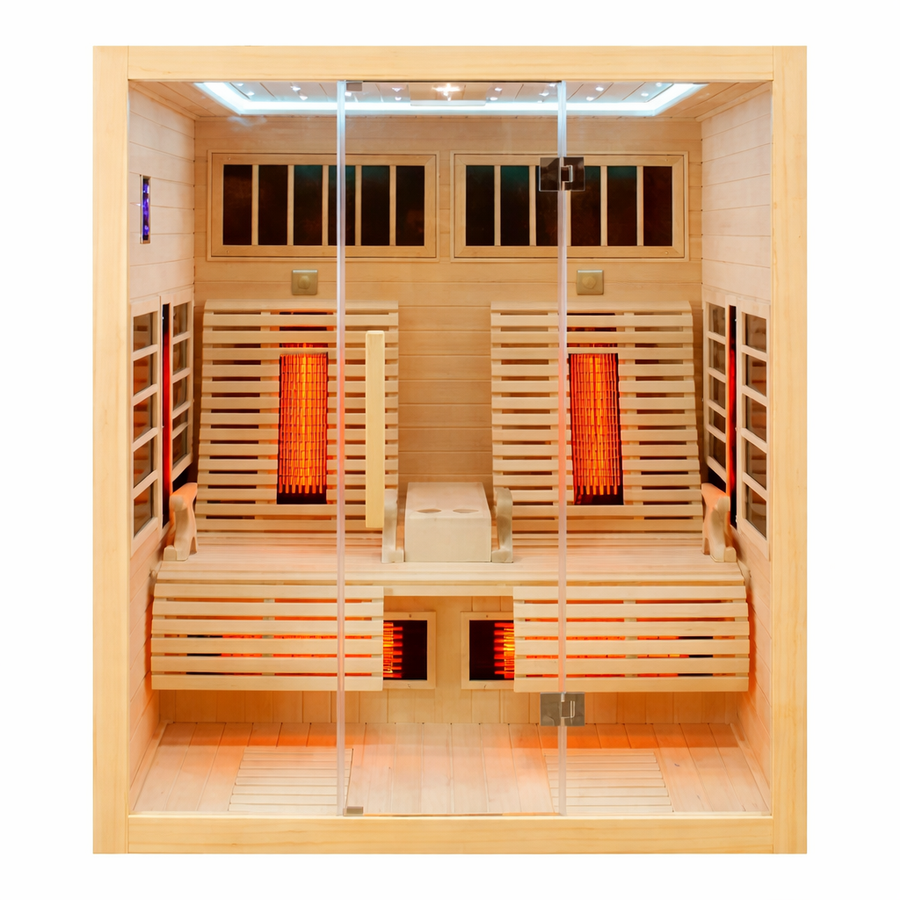
An infrared sauna uses infrared heating panels to provide radiant warmth rather than relying primarily on heating the surrounding air.
Infrared cabins generally operate at a lower air temperature than traditional saunas. Many people prefer the gentler heat, particularly when using a sauna as part of their relaxation or post-workout routine.
Infrared models can also be particularly practical indoors because compact one and two-person cabins are available.
Depending on the model, features may include:
- Far infrared or full-spectrum infrared heating
- Low-EMF heating systems
- Digital temperature controls
- Bluetooth audio
- Interior lighting
- App or Wi-Fi controls
Some smaller infrared saunas can connect to a standard UK socket, but this is not true of every infrared sauna. Always check the exact electrical specification before ordering.

What is a traditional sauna?
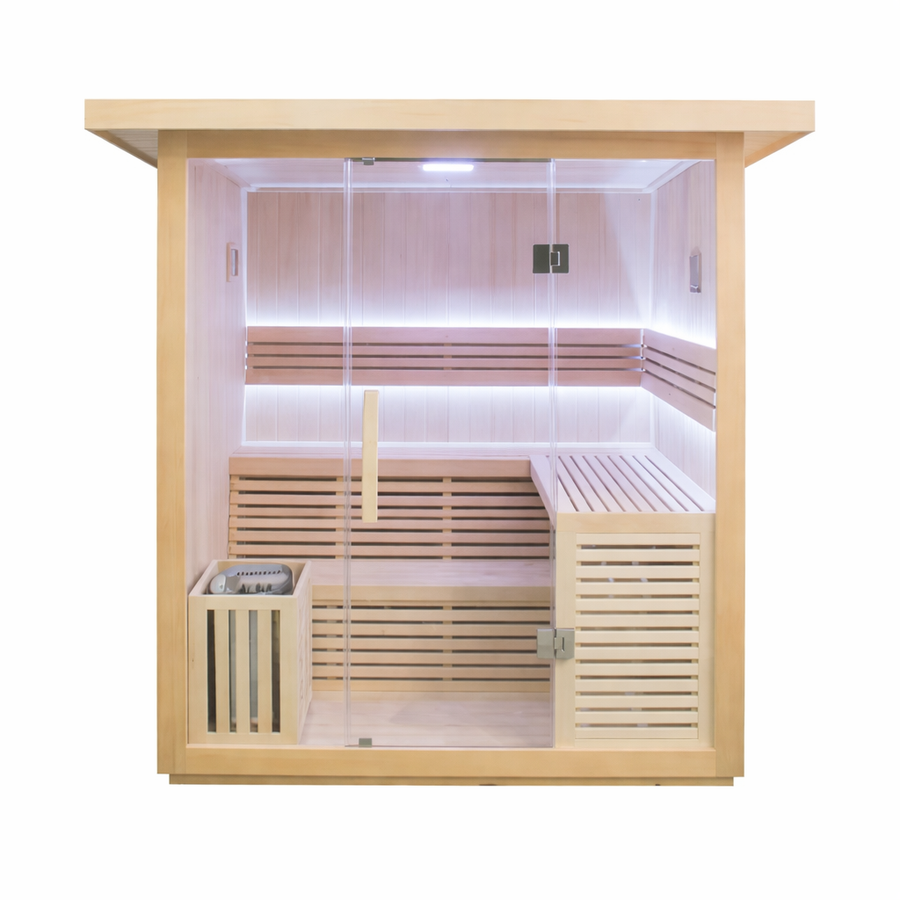
A traditional sauna heats the cabin using a sauna stove or heater, normally combined with sauna stones.
It produces the hotter air temperature associated with the classic Finnish sauna experience. Small amounts of water can be added to suitable heated stones to create bursts of steam and temporarily increase humidity.
This is sometimes referred to commercially as a traditional steam sauna, although it should not be confused with a steam room, which operates with continuously high humidity.
Traditional sauna culture has deep roots in Finland. For an interesting look at the experience itself, including sauna temperature, seating and traditional etiquette, read Best Served Scandinavia's guide to taking a sauna.
Traditional saunas are often the better choice for people who specifically want:
- Higher cabin temperatures
- A classic sauna stove and stones
- The option to add water to sauna stones
- A more traditional Finnish-style experience
- Larger indoor or outdoor sauna options
The trade-off is that larger traditional sauna heaters often require a dedicated electrical connection.
Infrared vs traditional sauna at a glance
| Feature | Infrared Sauna | Traditional Sauna |
|---|---|---|
| Heating style | Infrared panels warm the body more directly | Sauna stove heats the cabin and stones |
| Air temperature | Generally lower | Generally higher |
| Steam | No traditional steam from stones | Water may be added to suitable hot stones |
| Heat sensation | Gentler radiant warmth | Hotter, more intense cabin heat |
| Electrical setup | Some smaller models use a UK plug | Many models require hardwiring |
| Good for | Convenient home use and gentler heat | Classic sauna experience |
| Indoor options | Yes | Yes |
| Outdoor options | Available | Widely available |
You can compare both styles in the Gym Fitness Store sauna collection.
3. Choose the Right Sauna Size
Sauna capacity matters more than many buyers initially realise.
Home saunas can range from compact single-person cabins to much larger models designed for families or groups.
Ask yourself who will actually use the sauna at the same time.
1 person sauna
A one-person sauna can work well for someone who mainly wants a private sauna for individual use.
Its smaller footprint also makes it easier to incorporate into a bedroom, gym or other indoor space.
2 person sauna
A 2 person sauna is one of the most versatile choices for home use.
It provides additional room when used alone while making it possible for a partner or family member to join you without requiring the space of a large cabin.
3 to 4 person sauna
Larger cabins suit couples wanting additional room, families or people who expect to use the sauna socially.
Remember that advertised capacity describes how many people the cabin is designed to seat. It does not necessarily tell you how spacious it will feel.
Check the actual:
- Internal dimensions
- Bench length
- Cabin width and depth
- Door position
- Overall height
A tape measure is much more useful than guessing from product photographs.
4. Measure More Than the Sauna's Footprint
A common mistake is checking that the sauna itself fits and stopping there.
You also need enough room to install, access and use it comfortably.
Before ordering, check:
Door clearance: Is there enough room for the sauna door to open properly?
Ceiling height: Is there sufficient height above the cabin?
Assembly space: Can installers or whoever is assembling it work around the cabin?
Electrical access: Can the required supply reach the sauna safely?
Ventilation: Does the room provide suitable airflow?
Delivery route: Will the packaged components physically reach the installation area?
For an outdoor model, also check the complete roof dimensions. Roof overhangs can make the finished sauna wider than the main cabin dimensions suggest.
5. Check the Electrical Requirements Before Ordering
This is one of the most important parts of buying a sauna and one of the easiest to overlook.
Do not assume every sauna works from a normal household plug.
Some smaller infrared cabins are designed to connect directly to a standard UK socket. More powerful infrared units and many traditional sauna heaters require a dedicated circuit and hardwired electrical installation.
The specification to check includes:
- Rated power in watts or kilowatts
- Voltage
- Current requirement
- Plug-in or hardwired connection
- Any dedicated circuit requirements
For example, a compact infrared model may have very different requirements from a larger traditional or outdoor sauna.
Always follow the electrical instructions for the specific sauna you are purchasing. Where professional electrical work is required, this should be completed by a suitably qualified electrician.
It is much better to establish this before delivery than discover afterwards that additional electrical work is needed.

6. Think About Ventilation
Good airflow helps keep a sauna comfortable and allows heat and moisture to dissipate after use.
Ventilation requirements vary by sauna design and heater type, so follow the manufacturer's installation instructions rather than applying one general rule to every sauna.
Traditional sauna installations deserve particular attention because of the hotter operating environment and moisture created when water is used on the stones.
For an indoor installation, consider the ventilation of the room surrounding the sauna as well as the cabin itself.
After a session, allowing the sauna to air properly can also help the interior dry.
7. Look at the Sauna Materials and Construction
Sauna timber needs to cope with repeated changes in temperature, which is why the type and quality of construction matters.
Common sauna timbers include:
- Canadian Hemlock
- Cedar
- Spruce
- Thermally modified woods
Canadian Hemlock, for example, is widely used for indoor sauna cabins because of its appearance, stability and suitability for sauna construction.
For outdoor models, look beyond appearance. Check that the entire structure has been designed for outdoor conditions, including the roof and exterior materials.
Also inspect the less exciting details:
- Glass thickness and construction
- Door fittings
- Bench layout
- Insulation
- Floor construction
- Heater specification
- Warranty
- Replacement parts availability
These can matter far more over several years of ownership than decorative features alone.
8. Consider How the Sauna Will Be Assembled
Many home saunas are delivered flat-packed rather than arriving as one complete cabin.
That is worth knowing before your delivery arrives.
Check whether:
- The sauna is supplied flat-packed
- Full instructions are included
- More than one person is needed for assembly
- The heater requires separate installation
- Electrical work needs to be completed professionally
- The delivery is kerbside or brought into the property
Larger glass panels and timber sections can be heavy, so do not assume flat-packed means lightweight.
Access is especially important for outdoor saunas and larger multi-person cabins.
9. Indoor or Outdoor Sauna: Which Should You Choose?
Both can make excellent home saunas.
The better option depends primarily on your property and routine.
Choose an indoor sauna when:
- You have suitable space inside the house
- Convenience is a priority
- You want easy access after workouts
- You prefer a compact one or two-person model
- You do not want a separate garden structure
An indoor model can work particularly well alongside a home gym, creating one space for training and unwinding afterwards.
Choose an outdoor sauna when:
- Indoor space is limited
- You have a suitable garden or patio area
- You want a larger sauna
- You like the idea of a separate wellness area
- You want more freedom over cabin size and layout
Outdoor saunas are available in several designs, including traditional cabins, barrel saunas and modern garden sauna rooms.
Whatever you choose, make sure the product is rated for the environment where you intend to install it.
10. Which Sauna Features Are Actually Worth Having?
Modern saunas can come with an increasingly long list of extras.
Depending on the model, these might include:
- Digital control panels
- Wi-Fi or app controls
- Bluetooth speakers
- USB audio
- Interior reading lights
- Ambient or chromotherapy lighting
- Full-spectrum infrared
- Low-EMF infrared panels
- Temperature timers
- Glass fronts
- Ergonomic backrests
These features can make a sauna more enjoyable, but they should come after the fundamentals.
Get the heater, dimensions, electrical requirements, build quality and installation right first.
A sauna with impressive lighting is still the wrong sauna if it does not comfortably fit the room.
11. Consider How You Plan to Use Your Sauna
Think realistically about your routine.
Someone who wants a quick solo session after training may choose very differently from a family looking for a traditional garden sauna to use together at weekends.
Ask yourself:
- Will I normally use it alone?
- Will I use it after exercise?
- Do I prefer intense heat or gentler warmth?
- Will my partner or family regularly join me?
- Do I want it inside or in the garden?
- How often am I likely to use it?
- How important are smart controls and entertainment features?
- Would I rather plug it in or arrange professional electrical installation?
Your answers are more useful than simply asking which sauna is "best".
12. Don't Forget Sauna Safety and Everyday Use
Buying the right sauna is only part of the process. Knowing how to use it sensibly matters too.
New users should become comfortable with heat gradually, stay hydrated and leave the sauna if they begin to feel dizzy or unwell.
Sitting on a towel helps keep wooden benches cleaner, while allowing the cabin to air after use helps it dry.
Traditional Finnish sauna culture also places considerable emphasis on simple habits such as showering before entering, using a towel and keeping the sauna environment relaxed.
For more detailed advice, the CenturaHeat sauna etiquette and safety guide covers preparation, session length, cooling down and sauna etiquette for beginners.
Anyone with a medical condition, taking medication that can affect heat tolerance, or concerned about whether sauna use is suitable for them should seek appropriate medical advice.
Common Mistakes to Avoid When Buying a Home Sauna
Before making your final choice, watch out for these common mistakes.
Choosing on appearance alone
Design matters, but dimensions, heater type and electrical requirements should come first.
Buying a sauna that is too small
Think about how many people will genuinely use it and how much room you prefer when sitting.
Forgetting installation costs
Electrical work, base preparation or professional assembly may need to be considered alongside the purchase price.
Assuming every infrared sauna plugs in
Some do. Others do not. Check the exact specification.
Assuming any sauna can be installed outdoors
Only choose a model specifically suitable for outdoor use.
Ignoring delivery access
Check gates, driveways, doorways, stairs and the final route to the installation point before delivery.
Focusing too heavily on health claims
Choose a sauna because the heat style, space, quality and overall experience suit you rather than buying solely because of exaggerated wellness promises.
Home Sauna Buying Checklist
Before ordering, make sure you can answer yes to the following:
- I have measured the available width, depth and height.
- I have checked door and assembly clearance.
- I know whether I want infrared or traditional heat.
- I have chosen a realistic seating capacity.
- I know whether the sauna is indoor or outdoor rated.
- I have checked its power requirements.
- I know whether an electrician is required.
- I have considered ventilation.
- I have checked the delivery route.
- I understand how the sauna is supplied and assembled.
- I have checked the warranty and product specifications.
- I know the expected delivery arrangements.
If any of these are unclear, check them before placing your order.
Choosing the Right Home Sauna
There is no single sauna that will be right for every home.
For one person with limited indoor space, a compact infrared cabin could make the most sense. Someone wanting the classic hotter sauna experience may prefer a traditional model with stones. A household with limited indoor room may decide that an outdoor garden sauna provides far more flexibility.
The key is to work backwards from your space, preferred heat, number of users and installation requirements.
Once you know those four things, comparing models becomes much easier.
At Gym Fitness Store, we offer home wellness and fitness equipment for people looking to create practical training and recovery spaces at home.
Explore our full range of home saunas, including infrared, traditional, indoor and outdoor options, and compare the individual dimensions, heater specifications and installation requirements before choosing the model that best suits your home.

Frequently Asked Questions About Buying a Home Sauna
What should I look for before buying a home sauna?
Start with the available space, whether the sauna will be indoors or outdoors, the heating type, seating capacity and electrical requirements. Then compare materials, controls, installation, ventilation, warranty and additional features.
What size sauna is best for a home?
There is no single best size. A one-person sauna suits individual use and limited spaces, while a two-person sauna provides more flexibility without taking up as much room as a family-sized model. Three to four-person and larger saunas are better suited to families or social use.
Is an infrared or traditional sauna better?
Infrared saunas offer gentler radiant heat at lower air temperatures, while traditional saunas provide the hotter cabin environment and sauna-stone experience associated with Finnish-style sauna bathing. The better option depends on the type of heat you enjoy and your installation requirements.
Can I put a sauna in my home gym?
Yes, provided the model is suitable for indoor installation and the room meets its space, electrical and ventilation requirements. A home gym can be a convenient location for people who enjoy using a sauna as part of their post-training routine.
Do home saunas use a normal plug?
Some smaller infrared saunas can use a standard UK socket. Many traditional saunas and higher-powered models need to be hardwired into the electrical supply. Check the individual product specification rather than assuming.
Do I need an electrician to install a home sauna?
It depends on the sauna. A model designed for a standard UK plug may not need specialist electrical installation, while hardwired models require appropriate professional electrical work. Always follow the manufacturer's installation requirements.
Can a home sauna go outside?
Yes, but only choose a sauna designed and rated for outdoor use. The installation will also need a suitable level base, appropriate drainage and access to any required electrical supply.
Do home saunas need plumbing?
Many home saunas do not require a direct water supply. Traditional sauna users usually add small amounts of water manually to suitable heated sauna stones. Always check the particular model's requirements.
Are home saunas difficult to maintain?
Routine maintenance is generally straightforward. Keep benches and surfaces clean, allow the cabin to ventilate and dry after use, clean glass where necessary and follow the manufacturer's maintenance instructions for the heater and other components.
More stories

Exercise Bike vs Treadmill: Which Is Better?


Comments
A sauna can complement a balanced wellness routine, especially when paired with good hydration, recovery, and sustainable weight-management habits like those outlined at https://wegovypricecompare.com/discount-codes/