

What to Look for Before Buying a Home Sauna: A Comprehensive UK Beginner's Guide
Buying a home sauna is easier when you make a few practical decisions before comparing individual models.
The most important things to check are the type of heat you want, where the sauna will go, how much usable space you have, the electrical supply it requires, installation and ventilation requirements, total cost and the support available after purchase.
Getting those decisions right matters more than choosing the sauna with the longest feature list.
This home sauna buying guide explains each point so you can compare options confidently and avoid discovering installation problems after your sauna has arrived.
What Should You Check Before Buying a Home Sauna?
Before ordering a home sauna, check these seven areas:
- Sauna type: traditional, infrared or hybrid.
- Location: indoors or outdoors.
- Dimensions and access: not only where it will sit, but how it will reach that space.
- Electrical requirements: including heater output and whether specialist electrical work is needed.
- Installation requirements: flooring, ventilation, clearances and outdoor base preparation.
- Total budget: including delivery, assembly, electrical work and ongoing running costs.
- Warranty and aftercare: particularly heater, controls, infrared panels and replacement parts.
Manufacturer Harvia similarly recommends starting with practical questions such as who will use the sauna, how quickly you want it to heat and whether it will be installed indoors or outdoors. Its sauna buying guide is useful additional reading when comparing sauna formats.
Let's look at each decision in more detail.
1. Decide Between a Traditional, Infrared or Hybrid Sauna
The first major decision is how you want your sauna to produce heat.
Traditional and infrared saunas may look similar from the outside, but they create noticeably different experiences.

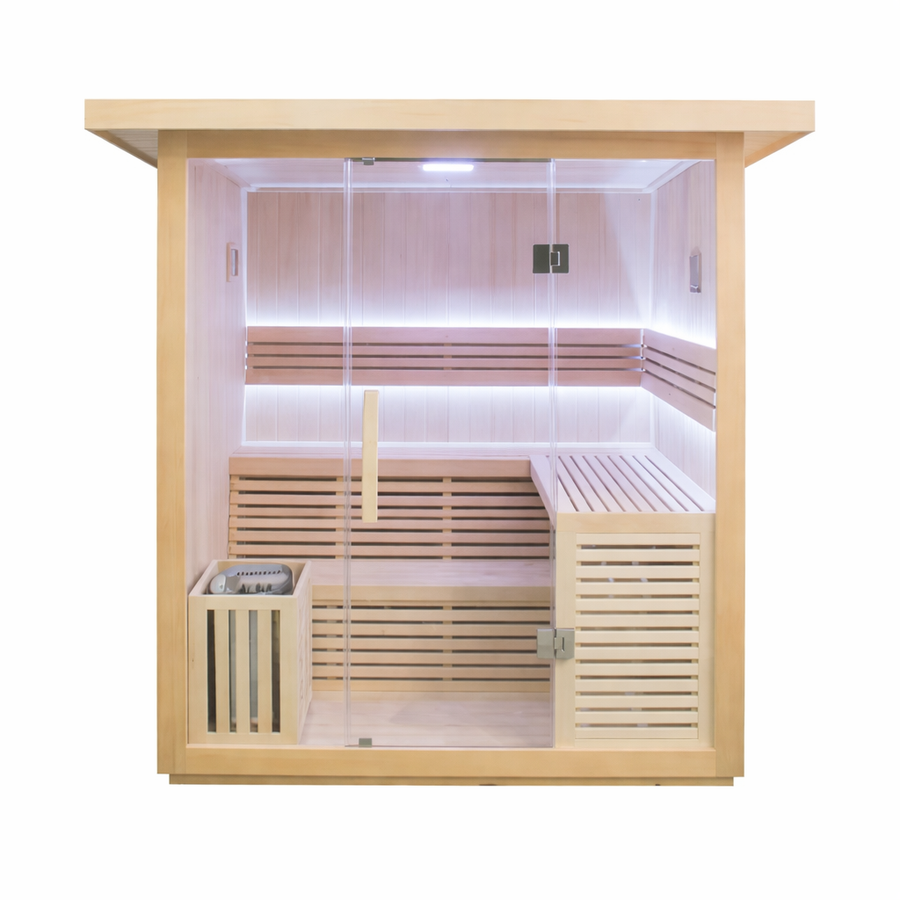
Traditional sauna
A traditional sauna uses a heater to warm the sauna room and, usually, a bed of sauna stones. Water can be carefully poured onto suitable heated stones to create a temporary increase in humidity known in Finnish sauna culture as löyly.
Harvia describes typical traditional sauna temperatures as around 70–100°C, although the operating range of an individual home sauna depends on its heater, controls, construction and manufacturer specifications.
A traditional sauna may suit you if you:
- want the classic high-temperature sauna experience
- enjoy using sauna stones and adding bursts of humidity
- are happy to allow additional warm-up time
- have the electrical supply required by the chosen heater
- prefer a more traditional sauna ritual

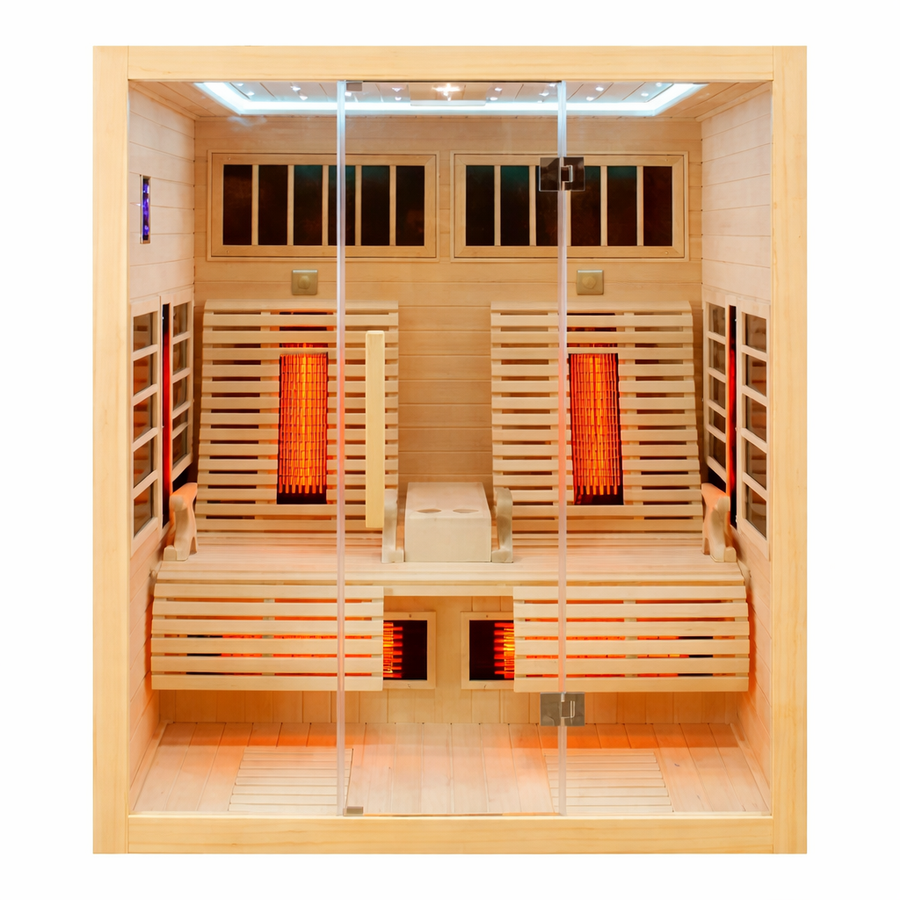
Infrared sauna
An infrared sauna uses infrared emitters or panels to warm the user more directly rather than relying primarily on heating the entire volume of air.
The air temperature is consequently usually lower. Harvia gives a typical infrared range of approximately 40–60°C.
Infrared can make sense if you prefer:
- gentler air temperatures
- relatively quick warm-up
- an indoor sauna with a compact footprint
- straightforward everyday use
- radiant rather than traditional hot-air heat
Do not assume, however, that every infrared sauna simply plugs into any available socket. Electrical requirements vary by model, particularly as sauna size and heater output increase.

Hybrid sauna
Hybrid models combine infrared heating with a more traditional sauna heating system.
They can be attractive where two people in the same household prefer different sauna experiences, although the extra heating equipment can make specifications, electrical requirements and price more complex.
Gym Fitness Store's current sauna range includes infrared, steam-stove/traditional and hybrid heating formats, so understanding these differences first makes filtering products much easier.
What about a "steam sauna"?
Product terminology can sometimes be confusing.
A traditional sauna heater with stones can create bursts of steam when water is added appropriately, but that does not automatically make the cabin the same as a steam room. A steam room normally uses a dedicated steam generator to maintain a much more humid environment.
Always check what heating system the product actually uses rather than relying solely on its marketing name.
2. Choose the Location Before Choosing the Sauna
One of the most useful rules for first-time sauna buyers is simple:
Choose the location first and the sauna second.
Once you know where it will live, you can rule out products that are too large, unsuitable for that environment or impractical to connect.

Indoor home sauna
An indoor sauna can work in spaces such as a spare room, home gym, suitable garage or dedicated wellness area, provided the room and product requirements are compatible.
Manufacturer guidance commonly calls for a dry, stable and suitably ventilated environment, with specific clearances around the cabin. Exact clearances vary between models and should always come from the installation manual rather than a generic rule.
Indoor installations are particularly convenient if regular use is your priority because the sauna remains easily accessible regardless of the weather.

Outdoor or garden sauna
An outdoor sauna gives you more freedom if indoor floor space is limited and can create a separate wellness area in the garden.
It does add several practical considerations:
- weather exposure
- drainage
- a suitable level base
- electrical cable routes
- distance from the house
- delivery access
- planning restrictions
- ongoing exterior maintenance
Harvia's guidance, for example, stresses the importance of a stable, level surface and appropriate drainage and airflow around an outdoor structure. The exact base specified for your sauna should always take priority over general guidance.
If you're still comparing wellness options rather than a specific model, the Gym Fitness Store Health & Wellness range also provides an overview of saunas, hot tubs and ice baths.
3. Measure More Than the Final Sauna Space
Finding enough floor space for the sauna itself is only the beginning.
Before ordering, record:
- available floor width and depth
- ceiling height
- required clearance around the cabin
- sauna door opening and swing
- nearby sockets, switches and radiators
- skirting boards or other obstructions
- doorway widths
- hallway turns
- staircases
- lifts, where relevant
- garden gates and side passages for outdoor models
Delivery access is an easy detail to overlook. A sauna can fit perfectly in a spare room and still be impossible to get there if a large panel cannot turn through the staircase or doorway.
Current UK buying guides increasingly highlight this as a genuine pre-installation issue.
Check the package or panel dimensions with the seller if they are different from the assembled dimensions.
4. Think About Capacity in Terms of Comfort, Not Just Headcount
A "two-person sauna" tells you roughly how many people it is designed to accommodate. It does not tell you how comfortable two adults will find it.
Before choosing a capacity, ask:
- Will you normally use the sauna alone or as a couple?
- Do you want to sit upright or lie down?
- How long is the usable bench?
- Is there one bench or more than one level?
- Will family or friends regularly join you?
- Is shoulder room more important than keeping the footprint small?
Harvia notes that bench layout can have a major effect on the sauna experience, with L-shaped, opposing and single-bench arrangements suited to different uses.
For a household of two, a larger three-person model may sometimes be more comfortable than the smallest possible two-person cabin if you value extra bench space. On the other hand, buying a much larger sauna than you regularly need can increase the footprint and energy required to heat it.
Choose for your normal use, not the largest gathering you can imagine having once a year.
5. Check the Electrical Requirements Before You Order
For many UK homeowners, electricity is the most important technical check to make before buying a sauna.
Do not order a model and only afterwards ask an electrician whether your home can supply it.
Do home saunas need special wiring?
Some do and some do not.
Compact infrared models may be designed around comparatively modest electrical loads, while traditional electric sauna heaters commonly have much higher outputs and may require a dedicated circuit.
Current UK buying guides show traditional domestic electric sauna heaters commonly in the multi-kilowatt range, while individual infrared cabins can require considerably less power. The correct answer must still come from the specification for the exact model you intend to buy.
Before paying for a sauna, give an electrician:
- the sauna model
- heater type
- rated power in kW
- voltage and phase requirements
- manufacturer wiring diagram
- proposed sauna location
- distance from the consumer unit
The electrician can then assess the existing installation and determine what additional work is necessary.
The Electrical Times guide to installing electric sauna heaters in the UK provides further industry context on selecting and installing electric sauna heaters. Electrical work must also meet the rules applicable in your part of the UK; in England, Approved Document P covers electrical safety in dwellings and explains notification requirements.
For a high-powered sauna heater, professional electrical advice is something to obtain before purchase, not something to arrange as an afterthought.
6. Check Ventilation, Flooring and Moisture Management
Saunas are hot environments and people generate moisture simply by using them. Traditional sauna use can introduce additional humidity when water is applied to suitable stones.
The installation therefore needs to deal with heat, moisture and airflow appropriately.
Check the manufacturer's requirements for:
- air inlet and outlet positions
- minimum ventilation clearances
- suitable flooring
- moisture resistance
- drainage, if applicable
- required distance from surrounding surfaces
- ventilation of the room containing an indoor cabin
Good ventilation is not simply about making the sauna comfortable. It also helps the structure dry after use.
Avoid assuming that because a cabin is described as a "dry sauna", the surrounding room requires no thought about ventilation or moisture.
7. Match the Heater to the Sauna Rather Than Chasing the Highest kW
A more powerful heater is not automatically a better heater.
The heater needs to be suitable for the internal volume and construction of the sauna. Too little output can mean slow heating and difficulty maintaining temperature, while simply installing a larger heater than the sauna requires is not necessarily beneficial.
Harvia highlights heater sizing and insulation as important parts of maintaining efficient heating.
For complete sauna cabins, the manufacturer will normally specify the appropriate heater or compatible heater range. Follow that specification rather than attempting to choose output on the basis of kW alone.
Also consider the type of control you actually want. Options can include:
- controls mounted directly on the heater
- separate digital controls
- programmable timers
- temperature presets
- lighting control
- Wi-Fi or app connectivity
Smart controls can be useful, but they should come after fundamental considerations such as safe installation, suitable heater output and good construction.
8. Look Beyond the Appearance of the Timber
Wood is an important part of sauna design, but the species name on the product page should not be your only measure of quality.
Common sauna timbers include hemlock, spruce, cedar, aspen and thermally modified woods.
More useful questions include:
- Is the timber intended for repeated heat exposure?
- How are the panels joined?
- Is the inside smooth and comfortable where skin may touch it?
- How well is the cabin insulated?
- How substantial do the benches feel?
- Is the exterior suitable for the intended indoor or outdoor location?
- How should the timber be maintained?
- Are replacement components available?
Large areas of glazing can produce a lighter, more open appearance, while solid timber cabins can feel more enclosed and traditional. Your choice is partly aesthetic, but insulation and heater sizing still need to work as a complete system.
For an outdoor sauna, pay particular attention to the roof, external finish, weather protection and maintenance instructions rather than assuming that any timber sauna can simply be positioned outside.
9. Calculate the Total Cost, Not Just the Sauna Price
The listed sauna price is only one part of the budget.
Depending on the model and location, your total project may also include:
- delivery
- assembly
- electrical work
- consumer-unit alterations
- outdoor cabling
- ground or base preparation
- ventilation work
- flooring
- planning or building-control advice
- accessories
- routine maintenance
The spread in current UK home-sauna pricing is wide because a compact infrared cabin and a large outdoor traditional sauna are fundamentally different projects. Current UK cost guides put entry-level sauna kits around the low thousands, with larger, custom and outdoor installations reaching considerably higher figures.
Rather than asking only "How much is the sauna?", ask:
"How much will this sauna cost to have fully installed and ready to use in my property?"
That is the figure worth comparing.

10. Consider Running Costs Before Choosing a Large Sauna
Running cost depends primarily on electrical power, warm-up time, session length and your electricity tariff.
A simple way to estimate electricity use is:
Power in kW × hours used = kWh consumed
You can then multiply that figure by your electricity unit rate.
For example, a 6kW heater operating continuously at full power for one hour would theoretically consume up to 6kWh. In real use, thermostatic control and the warm-up/maintenance cycle affect actual consumption.
Do not compare running costs from heater output alone. A lower-powered sauna that needs significantly longer to reach temperature can behave differently from a correctly sized higher-output heater.
The best comparison uses the manufacturer's specifications and a realistic idea of how frequently and for how long you expect to use the sauna.
11. Decide Which Extra Features You Will Actually Use
Modern home saunas can include features such as:
- Bluetooth audio
- integrated speakers
- coloured or ambient lighting
- digital touch controls
- Wi-Fi control
- app connectivity
- full-spectrum infrared
- multiple infrared emitter types
- ergonomic backrests
- glass fronts
- reading lights
These can improve the experience, but they should not distract from the fundamentals.
A well-built sauna that fits your property, has the right heating system and can be installed correctly is a better purchase than a poorly suited sauna with a long list of electronic extras.
For each premium feature, ask yourself: Would I pay for this feature if it were an optional upgrade?
If the answer is no, it probably should not determine which sauna you buy.
12. Check Warranty, Spare Parts and After-Sales Support
A home sauna contains components that may eventually need servicing or replacement.
Before purchasing, check what the warranty actually covers.
Look separately at:
- cabin or timber structure
- electric heater
- infrared emitters
- control panel
- lighting
- electronics
- labour
- replacement parts
Also check whether professional installation is a warranty condition and what maintenance the manufacturer expects you to carry out.
Current UK guides increasingly recommend checking spare-parts availability and understanding whether a warranty covers labour as well as components.
A five-year warranty is less reassuring if obtaining a replacement control panel several years later is difficult.
13. Check Delivery and Assembly Arrangements
Another useful question before buying is: What exactly happens on delivery day?
Find out:
- whether delivery is kerbside or to the installation location
- whether the sauna arrives flat-packed or partially assembled
- how many people are needed to move the components
- whether assembly is included
- whether an optional assembly service is available
- whether electrical commissioning is separate
- what needs to be prepared before the delivery team arrives
Some modular sauna cabins can be assembled by competent homeowners, while other products are better suited to professional installation.
Electrical connection should be treated separately from simply assembling timber panels.

14. Do You Need Planning Permission for an Outdoor Sauna?
A garden sauna does not automatically require planning permission, but you should check before ordering.
In England, the Planning Portal specifically includes sauna cabins within the rules governing ancillary outbuildings. Such buildings can qualify as permitted development if all relevant limits and conditions are met, including restrictions involving position, height, boundaries, garden coverage and designated land.
The important point for a UK-wide audience is that the rules are not identical across the four nations.
Wales publishes its own planning guidance for outbuildings, while Scotland has separate householder permitted-development rules and may also require a building warrant in some circumstances. Northern Ireland operates its own planning system and advises householders to confirm proposed development with the relevant council where necessary.
Be particularly careful if your property is:
- listed
- in a conservation area
- within other designated or protected land
- a flat or maisonette
- subject to restrictions on permitted-development rights
If there is any uncertainty, check with your local planning authority before purchasing the sauna or preparing its base.
15. Common Home Sauna Buying Mistakes to Avoid
Several problems are much easier to prevent before placing an order.
Buying based on appearance first
Start with heat type, location, dimensions and power. Design comes afterwards.
Measuring the room but not the access route
Check doors, stairs, hallways, gateways and the dimensions of the sauna's largest delivered components.
Assuming every infrared sauna uses a standard plug
Some do, but requirements vary. Check the exact rated electrical specification.
Forgetting installation costs
Electrical work, assembly, outdoor bases and cable runs can materially affect the real project cost.
Buying the smallest advertised capacity
A sauna that technically seats two people may not provide the comfort or bench length you expected.
Ignoring ventilation
Plan how air will move and how the sauna and surrounding area will dry after use.
Assuming planning rules are the same across the UK
They are not. Check the rules applying to your location and property.
Choosing features before fundamentals
Bluetooth speakers are useful only after you have confirmed that the sauna physically fits and can be safely powered.
A Simple Home Sauna Buying Checklist
Before placing your order, you should be able to answer all of the following:
- What type of heat do I prefer?
- Will the sauna be indoors or outdoors?
- What are the exact external dimensions?
- What clearance does the manufacturer require?
- Can every component reach the installation location?
- How many people will normally use it?
- Is the bench large enough for how I want to sit or lie?
- What is the sauna's electrical rating?
- Has an electrician checked the proposed supply where necessary?
- What ventilation is required?
- Is the floor or outdoor base suitable?
- What is included with delivery?
- Is assembly included?
- What additional installation costs should I budget for?
- What does the warranty cover?
- Are spare parts available?
- Have I checked any planning or building requirements that apply?
If you cannot answer one of the major questions about space, access, electricity or installation, resolve that point before buying.
Frequently Asked Questions
What type of home sauna is best for beginners?
There is no single best type. Infrared saunas can appeal to beginners who prefer lower air temperatures and relatively quick warm-up, while traditional saunas suit buyers who specifically want the classic hotter air, sauna stones and löyly experience.
Can I put a sauna inside my house?
Yes, many home saunas are designed specifically for indoor use. Suitable locations can include spare rooms, home gyms and appropriate garage or wellness spaces, provided the chosen model's requirements for flooring, ventilation, electrical supply and clearances can be met.
Does a home sauna need an electrician?
It depends on the model. Some lower-powered units may be designed for straightforward connection, while many traditional electric sauna heaters require a dedicated supply. Check the exact electrical specification and obtain advice from a qualified electrician before purchasing where fixed electrical work is required.
How big should a home sauna be?
Choose based on how many people will use it regularly and how you want to sit. A model advertised for two people may be adequate for two seated users, but a larger cabin can be more comfortable if you want additional shoulder room or space to stretch out. Bench dimensions matter as much as advertised capacity.
Is an infrared sauna cheaper to run than a traditional sauna?
Infrared saunas commonly operate at lower power and lower air temperatures than traditional electric saunas, but actual cost depends on the model, warm-up time, session length and electricity tariff. Compare rated power and realistic usage rather than relying on a general claim.
Do I need planning permission for a garden sauna?
Not necessarily. Many garden structures can fall within permitted-development rules, but the conditions depend on your location, building dimensions, position and property status. Planning frameworks also differ between England, Wales, Scotland and Northern Ireland, so check the rules applying to your property before installation.
Final Thoughts: What Matters Most When Buying a Home Sauna?
The best home sauna is not necessarily the largest, hottest or most expensive model.
It is the one that matches how you want to use it and what your property can realistically accommodate.
Start by deciding between traditional, infrared and hybrid heat. Then confirm your location, dimensions, delivery access and electrical requirements before comparing design features. Finally, work out the full installed cost and check the warranty and aftercare available.
Following that order makes it much easier to eliminate unsuitable options and compare the remaining models on factors that genuinely matter.
Once you know the type, size and installation requirements that suit your home, you can browse the Gym Fitness Store sauna range and compare indoor, outdoor, infrared and traditional options against your checklist.
A little preparation before buying can prevent a much more expensive problem after delivery.
More stories

3 Top Tips for Starting Your Home Fitness Journey

