

Outdoor Sauna vs Indoor Sauna: Which Is Better for Your Home?
Neither an indoor nor an outdoor sauna is automatically better. An indoor sauna usually makes sense when easy access, compact installation and protection from the weather are priorities. An outdoor sauna can be a better fit when you have more garden space, want to keep the sauna separate from the house or prefer a dedicated garden wellness area.
The right choice depends less on which sauna looks best online and more on where you have suitable space, how often you expect to use it, the electrical supply available and how much installation work your property requires.
There is another important distinction to understand straight away: indoor versus outdoor tells you where the sauna is designed to live. It does not necessarily tell you how the sauna produces heat.
You can find traditional and infrared saunas indoors, and outdoor ranges can include traditional, infrared and hybrid designs too. Gym Fitness Store's current ranges demonstrate that overlap clearly.
This guide compares indoor and outdoor saunas across space, installation, cost, maintenance, planning, day-to-day use and heating options so you can decide which works better for your home.
Indoor vs Outdoor Sauna: The Quick Comparison
| Consideration | Indoor Sauna | Outdoor Sauna |
|---|---|---|
| Best suited to | Spare rooms, home gyms, suitable garages and wellness rooms | Gardens, patios and dedicated outdoor wellness areas |
| Everyday access | Very convenient | Requires going outside |
| Indoor space required | Yes | No |
| Garden space required | No | Yes |
| Weather exposure | Minimal | Requires outdoor-suitable construction |
| Base preparation | Usually a solid, level indoor floor | Usually requires a suitable solid, level outdoor base |
| Drainage considerations | Depends on room and sauna | Outdoor drainage and standing water need consideration |
| Planning considerations | Usually fewer siting issues | Planning rules may apply |
| Exterior maintenance | Minimal | More exterior inspection and care |
| Electrical installation | Model-dependent | Model-dependent, often requiring an outdoor cable route |
| Heating options | Infrared, traditional and hybrid models available | Traditional, infrared and hybrid options can be available |
| Experience | Integrated into the home | Separate garden retreat |
| Best overall? | Depends on your property and routine | Depends on your property and routine |
The key point is that neither column is inherently superior.

What Is an Indoor Sauna?
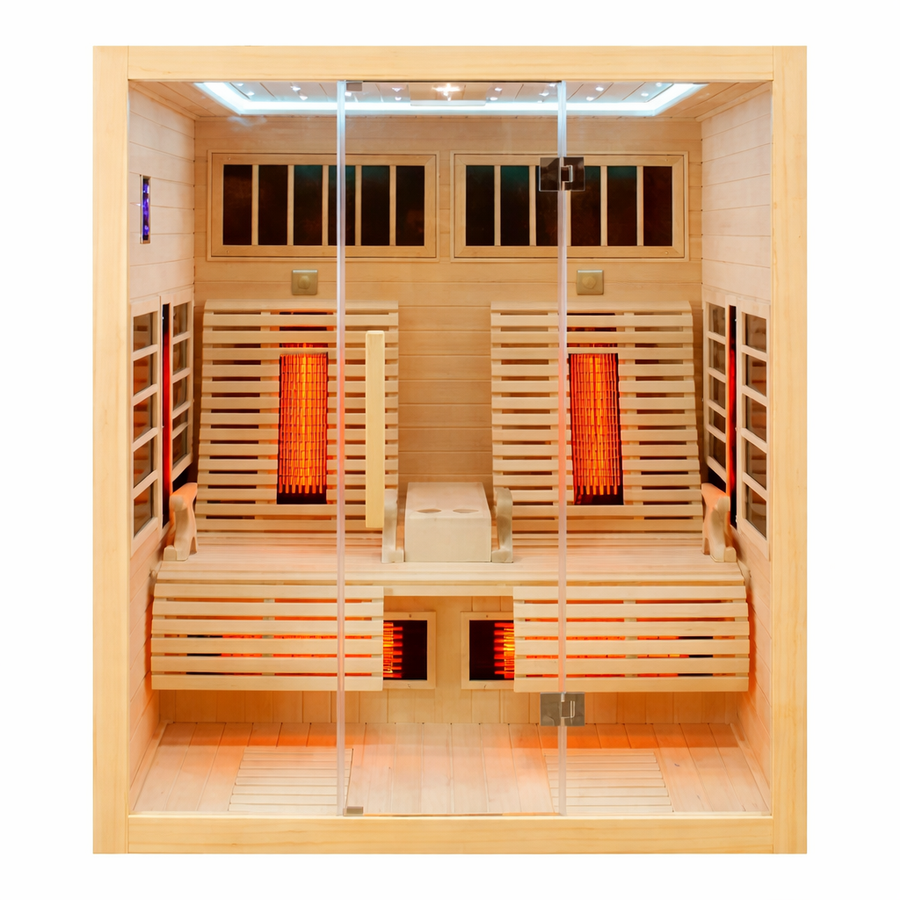
An indoor sauna is a sauna designed to be installed within a suitable enclosed area of the home or another appropriately prepared indoor space.
Potential locations include:
- a home gym
- spare room
- suitable garage
- large bathroom or wellness area
- dedicated sauna room.
Some indoor saunas are freestanding cabins that arrive in panels and are assembled inside the room. Others can form part of a purpose-built sauna installation.
Gym Fitness Store currently offers both infrared and traditional models designed for indoor use, so choosing to install your sauna inside does not limit you to one heating method.

What Is an Outdoor Sauna?
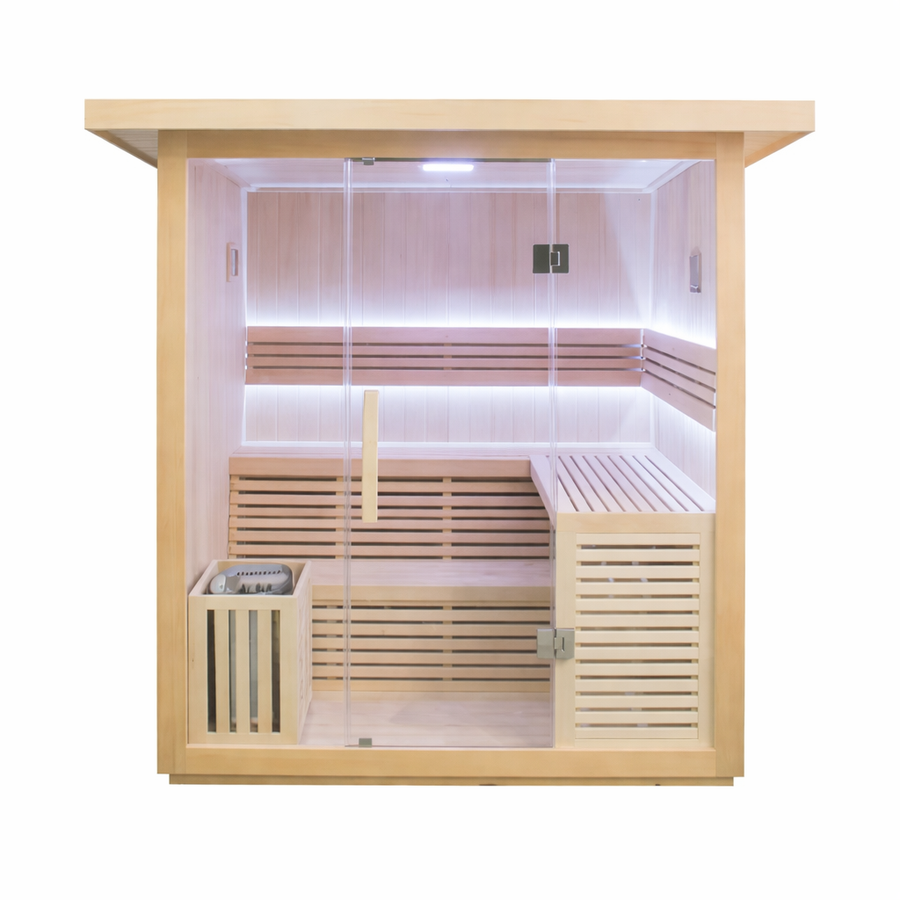
An outdoor sauna is specifically designed to withstand installation outside the main home.
Common formats include:
- garden sauna cabins
- barrel saunas
- cube saunas
- square sauna houses
- larger outdoor wellness cabins.
Outdoor construction needs to take account of rain, moisture, seasonal temperature changes and other weather exposure that an indoor sauna does not experience.
Gym Fitness Store's current outdoor sauna collection includes traditional steam-stove models alongside infrared and hybrid options, so outdoor does not necessarily mean one particular heating system.
Which Is More Convenient to Use?
Indoor saunas generally offer the shortest and simplest route from everyday life into a sauna session. Outdoor saunas add a journey into the garden, but some owners deliberately prefer that separation.
If your sauna is a few steps away from your home gym or bathroom, using it after training or in the evening can become part of an easy routine.
That can make an indoor sauna particularly attractive if you expect to use it frequently and value convenience.
An outdoor sauna changes the experience slightly.
You may need to:
- walk through the garden
- prepare outdoor lighting in winter
- keep pathways accessible
- move between the house, sauna and shower or cold-plunge area.
For some buyers, those extra steps are inconvenient.
For others, they are part of the appeal. A separate sauna can feel more like leaving the house and entering a dedicated space to switch off.
The better option depends on which setup you are more likely to actually use regularly.
Which Uses Space More Efficiently?
 Indoor sauna
An indoor model makes sense if you have underused interior space.
A compact sauna can transform part of a home gym, spare room or suitable garage without requiring additional garden development.
The trade-off is obvious: the sauna permanently occupies some of your indoor floor space.
For a smaller house where every room already has a purpose, that can be a significant disadvantage.
 Outdoor sauna
An outdoor sauna lets you preserve indoor living space.
That can be particularly useful for households where there is plenty of garden space but no suitable room inside the property.
Gardens can also accommodate larger sauna cabins more easily than many spare rooms.
However, usable garden space is not the same as empty garden space.
You still need to consider:
- distance from boundaries
- access from the house
- space around the structure
- drainage
- electrical cable routes
- pathways
- delivery access
- planning restrictions.
The best location is not simply the largest empty patch of lawn.
Which Is Easier to Install?
Indoor saunas often avoid outdoor groundwork, while outdoor saunas can avoid altering an existing room. Which is easier depends on what your property already has.

Installing an indoor sauna
For a freestanding indoor cabin, you will normally need:
- a solid, level surface
- enough ceiling height
- sufficient clearance around the sauna
- a dry, appropriately ventilated room
- a suitable electrical supply
- enough access to bring the sauna panels into position.
Gym Fitness Store's current indoor sauna product guidance specifies installation on a level, solid indoor surface with adequate clearance for ventilation and access.
Do not only measure the finished sauna footprint.
Measure:
- front and back doors
- hallways
- tight corners
- stairs
- landings
- garage entrances
- the sauna's largest individual panels.
A sauna that fits comfortably in the final room is not useful if its components cannot reach it.

Installing an outdoor sauna
Outdoor installation shifts the practical work outside.
A typical installation may require:
- a suitable level base
- effective drainage
- an electrical route from the property
- clear access for delivery
- sufficient space around the sauna
- planning checks
- protection from persistent standing water.
Gym Fitness Store's outdoor installation information calls for a solid, level base, adequate clearance and drainage, with protection from standing water where possible.
That makes outdoor installation a slightly different project, rather than simply putting an indoor cabin in the garden.
Can You Put an Indoor Sauna Outside?
You should not assume that an indoor sauna can be installed outside.
Indoor and outdoor models are constructed for different environments.
Outdoor saunas need materials, roofing and construction details designed to deal with weather exposure. An indoor sauna may not have the external protection needed to withstand repeated rain, frost, UV exposure and seasonal moisture.
If you want a garden sauna, select a model specifically identified by the manufacturer as suitable for outdoor use.
Likewise, do not assume an outdoor sauna should automatically be installed indoors. Follow the intended installation environment and clearances for the specific model.
Which Has Simpler Electrical Requirements?
Neither. Electrical requirements depend much more on the heater and rated power of the specific sauna than on whether it is indoors or outdoors.
This is one of the most important buying points.
For example, Gym Fitness Store currently lists an indoor infrared model rated at 1,400W that is designed to use a standard UK socket. It also lists an outdoor traditional sauna with a 3,500W heater that requires a hardwired connection by a qualified electrician.
That does not mean every indoor sauna is plug-in.
Traditional indoor saunas can also use higher-powered electric heaters requiring specialist electrical work.
Before ordering either an indoor or outdoor sauna, check:
- total rated power
- heater output
- voltage
- connection requirements
- cable specifications
- location of the consumer unit
- proposed cable route.
For outdoor installations, the length and route of the electrical supply may add further work.
If the sauna requires fixed electrical work, ask a qualified electrician to assess the proposed installation before buying.

Do Outdoor Saunas Need Planning Permission in the UK?
Not always. Some outdoor saunas can fall within permitted-development rules, but you should check the rules applying to your property before ordering.
In England, the Planning Portal specifically lists sauna cabins among the garden buildings covered by outbuilding rules. Outbuildings can be permitted development when all relevant limits and conditions are met.
The rules consider factors including:
- position relative to the house
- overall height
- eaves height
- distance from boundaries
- amount of garden covered
- whether the property is on designated land
- whether permitted-development rights have been restricted.
Do not simply copy England's measurements if you live elsewhere in the UK.
Wales publishes separate outbuilding guidance and also allows certain outbuildings as permitted development subject to conditions.
Scotland has its own permitted-development system and householder rules.
In Northern Ireland, planning operates through a separate system and NI Direct recommends contacting the appropriate council planning office if you are uncertain whether your work is permitted.
Listed buildings, conservation areas and other protected or restricted properties may also need additional consideration.
Planning is therefore something to check before buying an outdoor sauna, not once the cabin has arrived.
Which Is Better for the UK Weather?
An indoor sauna is naturally shielded from rain, wind, frost and direct sunlight by the house.
That generally means fewer exterior maintenance considerations.
An outdoor sauna is built specifically to live in the garden, but being designed for outdoor use does not make it maintenance-free.
UK weather means you should periodically inspect:
- roof condition
- exterior timber
- seals
- drainage
- base condition
- signs of standing water
- exposed fixings
- exterior finishes.
A properly designed outdoor sauna can be used throughout the year, but its installation and maintenance need to recognise that it is effectively an outdoor timber structure as well as a sauna.
Can You Use an Outdoor Sauna in Winter?
Yes, an outdoor sauna designed for year-round outdoor use can be used during the UK winter, provided it has been correctly installed and maintained.
Cold weather may influence warm-up time because the sauna starts from a lower ambient temperature, although the effect will depend on the sauna's construction, insulation, heater size and outside conditions.
Do not compensate by installing a larger heater than the sauna manufacturer specifies.
A correctly sized heater and appropriately constructed cabin should be treated as a system.
For some owners, winter is precisely when an outdoor sauna becomes most appealing. Others prefer the simplicity of walking straight into an indoor sauna without crossing a cold or wet garden.
Again, this comes down to how you want to use it.
Is an Indoor Sauna Easier to Maintain?
Indoor saunas generally require less exterior maintenance because they are protected by the building. However, the inside of both indoor and outdoor saunas still requires appropriate cleaning, drying and ventilation.
Indoor owners mainly need to think about:
- cleaning benches
- drying the cabin
- ventilation
- checking heater stones where fitted
- keeping controls and heaters in good condition
- protecting the surrounding room from excess moisture.
Outdoor owners have the same interior tasks plus exterior inspections and weather-related maintenance.
That gives indoor saunas a maintenance advantage in one area, but it does not make maintenance particularly complicated for a well-designed outdoor sauna.
Which Costs More: Indoor or Outdoor Sauna?
There is no universal answer because the total installed cost matters more than the sauna's advertised purchase price.
An indoor sauna project can include:
- sauna purchase
- delivery
- assembly
- electrical work
- ventilation work
- room preparation
- flooring or alterations.
An outdoor project can include:
- sauna purchase
- delivery
- assembly
- base preparation
- drainage
- electrical cable installation
- landscaping or access work
- planning advice where needed.
Outdoor projects can therefore accumulate additional site-preparation costs.
However, that does not mean every outdoor sauna costs more than every indoor sauna.
Gym Fitness Store's current catalogue contains a substantial price overlap between larger indoor traditional saunas and smaller outdoor models, reinforcing the point that size, heater, design and specification matter alongside location.
The best question is therefore not:
"Which sauna costs less?"
It is:
"What is the total cost of getting this particular sauna safely installed and ready to use in my property?"
Is an Outdoor Sauna More Expensive to Run?
Not necessarily.
Electricity consumption is primarily influenced by factors such as:
- heater output
- warm-up time
- session duration
- insulation
- cabin volume
- how frequently the heater cycles
- electricity tariff.
Outdoor temperature can affect warm-up conditions, particularly in winter, but simply knowing that a sauna is indoors or outdoors is not enough to calculate its running cost.
The basic energy calculation is:
heater power in kW × operating time in hours = kWh
You can then multiply the result by your electricity unit rate.
For example, two saunas of very different sizes should not be compared simply on location. A compact outdoor sauna with an appropriately sized heater may have very different requirements from a large six-person indoor sauna.
Compare individual specifications instead.
Does Indoor vs Outdoor Change the Health Benefits?
There is no good reason to assume that a sauna provides greater health benefits simply because the cabin is indoors or outdoors.
The physiological effects associated with sauna bathing come primarily from exposure to heat rather than the postcode of the cabin.
Forbes Health's overview of the research into sauna benefits discusses areas including relaxation and cardiovascular health, while also noting that some findings remain preliminary.
Similarly, Healthline's medically reviewed guide to sauna benefits and precautions notes potential benefits including relaxation and cardiovascular effects while stressing that the research is mixed and some proposed benefits require further evidence.
For a buyer choosing between indoor and outdoor, location should therefore be decided mainly on practical use, installation and personal preference, rather than assuming one location is healthier.
What About Infrared vs Traditional Sauna?
This is where two decisions are often incorrectly combined.
Indoor vs outdoor describes location. Infrared vs traditional describes how the sauna produces heat.

Infrared sauna
Infrared emitters warm the user more directly and normally operate with a lower surrounding air temperature.
Infrared cabins are particularly common indoors, but they are not exclusively indoor products. Gym Fitness Store's infrared collection currently contains predominantly indoor models alongside outdoor infrared and hybrid options.

Traditional sauna
A traditional sauna uses a heater to warm the cabin and sauna stones. Water can usually be applied appropriately to heated stones to create temporary increases in humidity.
Traditional saunas can be installed both indoors and outdoors where the model is designed for the intended location.
So your decision sequence should ideally be:
1. Where will the sauna go?
2. What heating experience do I want?
3. Which models satisfy both requirements?
That is more useful than assuming all indoor saunas are infrared or all garden saunas are traditional.
Indoor Sauna Advantages
An indoor sauna can be particularly attractive because it:
- provides quick access from inside the home
- avoids direct weather exposure
- requires no garden footprint
- can make use of an underused room
- works well beside a home gym or shower
- usually requires less exterior maintenance
- can suit compact one or two-person installations.
You can compare suitable models in the wider Gym Fitness Store home sauna range, which currently includes indoor infrared and traditional options.
Indoor Sauna Drawbacks
An indoor sauna may be less suitable if:
- interior floor space is already limited
- there is no practical ventilation arrangement
- delivery access is difficult
- the available room is too small
- you want a larger social sauna
- major room alterations would be necessary.
It is also important to make sure the room itself is suitable rather than fitting a sauna into the only spare corner available.
Outdoor Sauna Advantages
An outdoor sauna can:
- preserve valuable indoor floor space
- accommodate larger designs more easily
- create a separate garden wellness area
- work well alongside a hot tub or cold plunge
- provide greater freedom over placement and style
- create separation between everyday home life and the sauna.
You can compare dedicated outdoor and garden saunas available from Gym Fitness Store, including cabin, barrel and cube-style models.
Outdoor Sauna Drawbacks
An outdoor installation may involve:
- base preparation
- longer electrical cable routes
- garden access requirements
- planning checks
- additional exterior maintenance
- exposure to UK weather
- a longer walk from the house.
None of those points makes outdoor saunas inherently worse. They simply need to be included in the project before you order.
Which Sauna Is Better for a Home Gym?
An indoor sauna often integrates naturally with a home gym because it allows you to move directly between training, showering and the sauna without going outdoors.
But if the gym already occupies most of the available indoor space, an outdoor sauna could actually make the better overall layout.
Think about the full sequence:
training → cooling down → shower → sauna → changing
Where does that flow work naturally on your property?
A sauna positioned logically within your routine is likely to be more useful than one chosen simply because it looked better in isolation.
Which Is Better for Couples or Families?
Capacity matters more than location.
A compact indoor sauna may be ideal for one person or a couple.
A larger outdoor cabin may make more sense for a family because garden space often makes a bigger footprint easier to accommodate.
However, Gym Fitness Store also stocks larger indoor traditional options, so outdoor is not automatically required for multi-person use.
Check:
- bench dimensions
- seating layout
- advertised capacity
- usable internal space.
A manufacturer's "four-person" rating does not necessarily tell you how spacious four adults will find the cabin.
How to Decide Between an Indoor and Outdoor Sauna
Start with your property rather than the product catalogue.
Choose an indoor sauna if:
- you have a suitable spare indoor space
- everyday convenience matters most
- you want direct access from a gym or bathroom
- you have little or no suitable garden space
- you want less exterior maintenance
- a compact sauna suits your normal usage.
Choose an outdoor sauna if:
- you have more usable garden space than indoor space
- you want to keep the sauna separate from the house
- you prefer a larger cabin
- you want to create a dedicated garden wellness area
- you are prepared to arrange a suitable base and electrical route
- you enjoy the idea of the outdoor sauna ritual.
Neither list represents a better sauna.
It represents two different ways of fitting sauna ownership into a home.
Common Indoor vs Outdoor Sauna Buying Mistakes
1. Choosing the sauna before choosing the location
Confirm where the sauna can realistically go before falling in love with a particular model.
2. Assuming indoor means infrared
Traditional saunas can also be installed indoors.
3. Assuming outdoor means traditional
Outdoor infrared and hybrid models also exist.
4. Putting an indoor sauna outdoors
Only use a sauna in the environment it is designed for.
5. Measuring the final space but not the delivery route
Measure doors, corridors, stairs and garden access too.
6. Ignoring electrical requirements until after purchase
Check the exact rated power and connection requirements before ordering.
7. Assuming every garden sauna avoids planning permission
Check the rules applying to your UK nation, local authority and property.
8. Comparing purchase price rather than installed cost
A cheaper cabin can become the more expensive project if substantial electrical, building or ground preparation is required.
Indoor vs Outdoor Sauna Checklist
Before buying, answer these questions:
- Where do I have the most suitable usable space?
- How often do I expect to use the sauna?
- How many people will normally use it?
- Do I prefer infrared, traditional or hybrid heat?
- What electrical supply does the exact model need?
- Can the sauna components reach the installation location?
- Does an outdoor installation need a new base?
- Is drainage adequate?
- Have I checked planning requirements where relevant?
- What maintenance will each location require?
- What will the total installed cost be?
If you can answer those questions, the indoor versus outdoor decision becomes considerably easier.
Final Thoughts: Should You Choose an Indoor or Outdoor Sauna?
There is no single winner in the outdoor sauna vs indoor sauna comparison.
An indoor sauna makes a strong choice when you value easy access, have suitable interior space and want the sauna integrated into your home or fitness setup.
An outdoor sauna makes just as much sense when garden space is easier to spare, you want a larger or more separate sauna environment, or you want to create a dedicated wellness area outside.
The most useful approach is to decide in this order:
location → heating style → size → electrical requirements → installation cost → design and features.
That prevents you from choosing a sauna that looks perfect but does not work with your property.
Gym Fitness Store offers both indoor and outdoor home sauna options, so there is no need to make one format fit a property that naturally suits the other.
If your available space is mainly in the garden, explore the dedicated outdoor sauna collection.
The best home sauna is ultimately the one that fits comfortably into your space, your routine and the way you actually want to use it.
Frequently Asked Questions
Is an indoor or outdoor sauna better?
Neither is universally better. Indoor saunas generally favour convenience, protection from the weather and compact installation, while outdoor saunas preserve indoor space and can create a larger dedicated garden wellness area. The better option is the one that fits your property and expected routine.
Can you put a sauna inside a house?
Yes. Home saunas can be installed in suitable indoor spaces including home gyms, spare rooms, garages and dedicated wellness areas. The location must meet the sauna manufacturer's requirements for floor strength, ventilation, clearances and electrical supply.
Can an infrared sauna go outdoors?
Only if the specific model is designed and approved for outdoor use. Most infrared cabins are intended for indoor installation, but outdoor infrared and hybrid models are available. Gym Fitness Store's current infrared collection includes both indoor and outdoor options.
Do you need planning permission for an outdoor sauna?
Not always. In England, sauna cabins can fall within permitted-development rules for outbuildings when the relevant conditions are satisfied. Wales, Scotland and Northern Ireland have their own planning systems, so check the guidance applicable to your property before installation.
Does an outdoor sauna need a concrete base?
Not every manufacturer specifies concrete, so there is no universal base material. What matters is following the requirements for the exact sauna. Outdoor models generally need a stable, solid and level foundation with suitable drainage and protection from standing water. Gym Fitness Store's current outdoor guidance specifies a solid, level base.
Is an outdoor sauna harder to maintain?
An outdoor sauna usually requires more exterior care because it is exposed to weather. Its internal cleaning and heater maintenance are broadly similar to an equivalent indoor sauna, while the roof, exterior timber, seals, base and drainage require additional periodic inspection.
More stories


